

Samita Rungkwansiriroj
b. 1994, currently lives and works in Bangkok, Thailand
Textile designer graduated from the reputable Central Saint Martins. with Bachelor of Arts in Textile Design. Her fascination in textile and art has begun from a very young age, but woven textile art is what has drawn her into the most. From the starting point of understanding pace and rhythm of weaving, she found weaving is more likely another language. And with her admiration in dedication of craftsmanship, she believes in while weaving thread by thread is her record of time. Years of experience gained from working in prominent textile companies and material industries have resutted in an in-depth knowledge of not only fundamental hand skills, but also innovative approaches and self-developed techniques practicing. Her intention to clear people's thought of traditional woven textile and introducing handwoven textile as another canvas to possibly convey her narrative. Samita Rungkwansiriroj initiates her creative process with the challenge of combining weaving techniques with leather material. She intertwines the natural lines of leather with the arrangement of lines from weaving, presenting a new dimension through combinations of the stiffness and strength of leather with more delicate textiles.
To relate, to control
“To design is to plan and to organize, to order, to relate and to control. In short, it embraces all means of opposing disorder and accident. Therefore, it signifies a human need and qualifies man’s thinking and doing.” — Josef Albers, Dimensions of Design (1958).
Rooted in woven textiles, understanding the systems and constructions beneath the cloth has shaped not only how I create, but how I think. I continue this approach by forming systems that are mine — visual and structural languages through which I communicate. Having control over my vision and arranging my deeper thoughts defines my interpretation of modularity. Still, modularity is also about relation — how each connects, responds within the whole, and relates back to me.
This body of work stems from a fundamental gesture of ordering, referring to the Fibonacci Sequence, a natural pattern of increasing numbers. It forms a balance of density that unfolds and develops throughout. Yet certain squares and lines are allowed to shift, reflecting something more personal, my own ideal ratio formed instinctively. Stitched, inlaid, woven, and mark-making, this work is a quiet negotiation between system and intuition — between the grid and the hand. Materials such as parchment and raffia are chosen not only for their tactile quality but for their responsiveness — revealing both the precision of planning and the traces of the human hand.
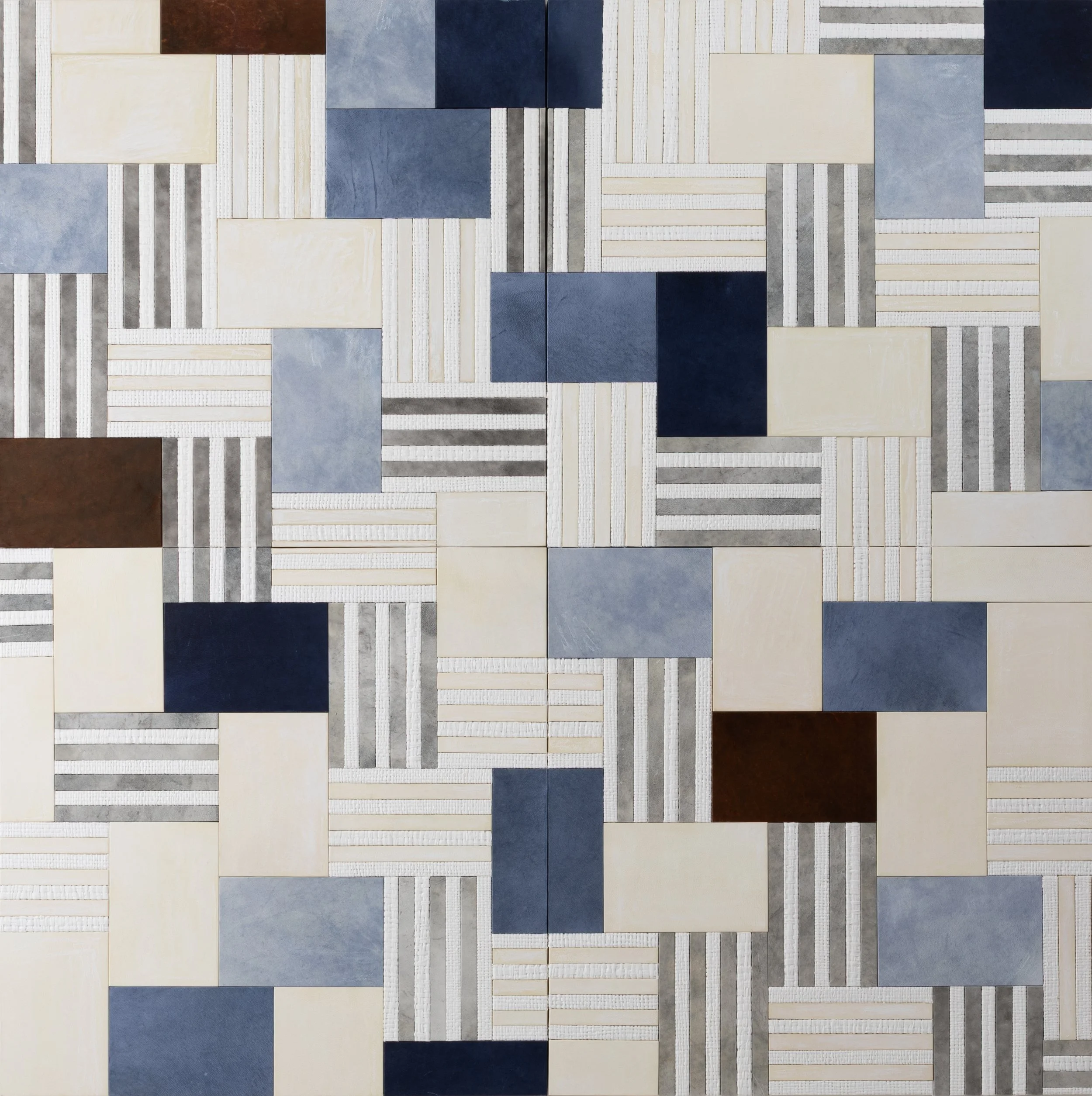
“The Twill” is a large-scale interpretation of twill cloth. This work emphasizes the physicality and dimensionality of woven fabric, often perceived as a seamless whole, yet always a structure — a system of modules combined, each piece interlocking to form the larger composition.
“Quartet I” and “Quartet II” reflect my ideal ratio — four distinct squares placed in the center. The title plays on the idea of a jazz quartet, portraying the balance and rhythm found in music and modularity. “Unsquared Dance,” the final celebration named after The Dave Brubeck Quartet, expresses repetition, sequencing, and measured interruption. Together, these works reveal a visual language of rhythm and restraint.
Embraced as an intentional act — one that relates, organizes, and controls. They resist chaos not through rigidity, but with a structure that breathes.
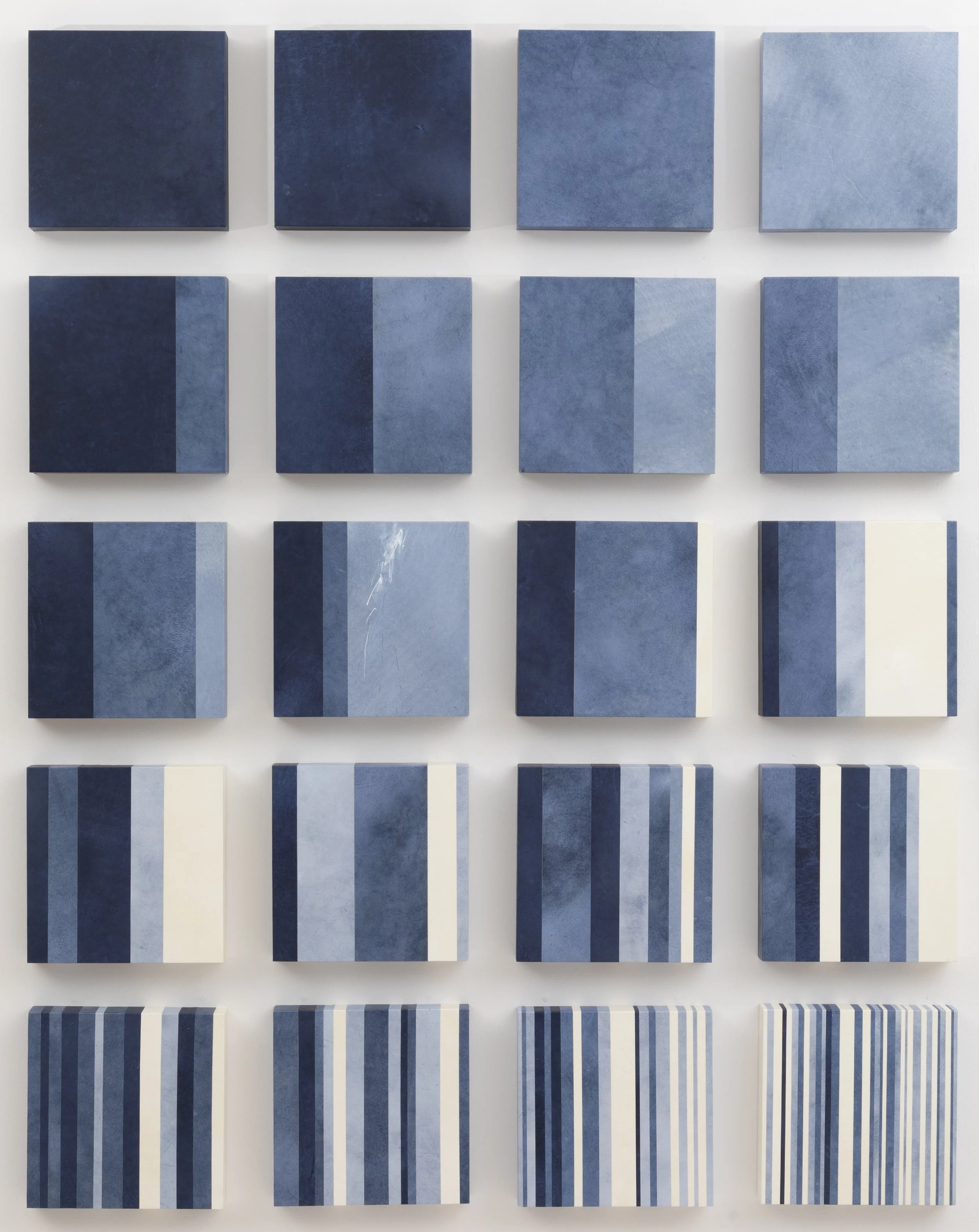
Twentieth Sequence (2025)
Goat leather parchment inlay with oil pastel
24 × 24 × 4 (total 144 × 114 × 4) cm.
The Twill (I - IV) (2025)
Composition of goat leather parchment and raffia handloom weaving with oil pastel
60 × 60 × 4.5 (total 120 × 120 × 4.5) cm.
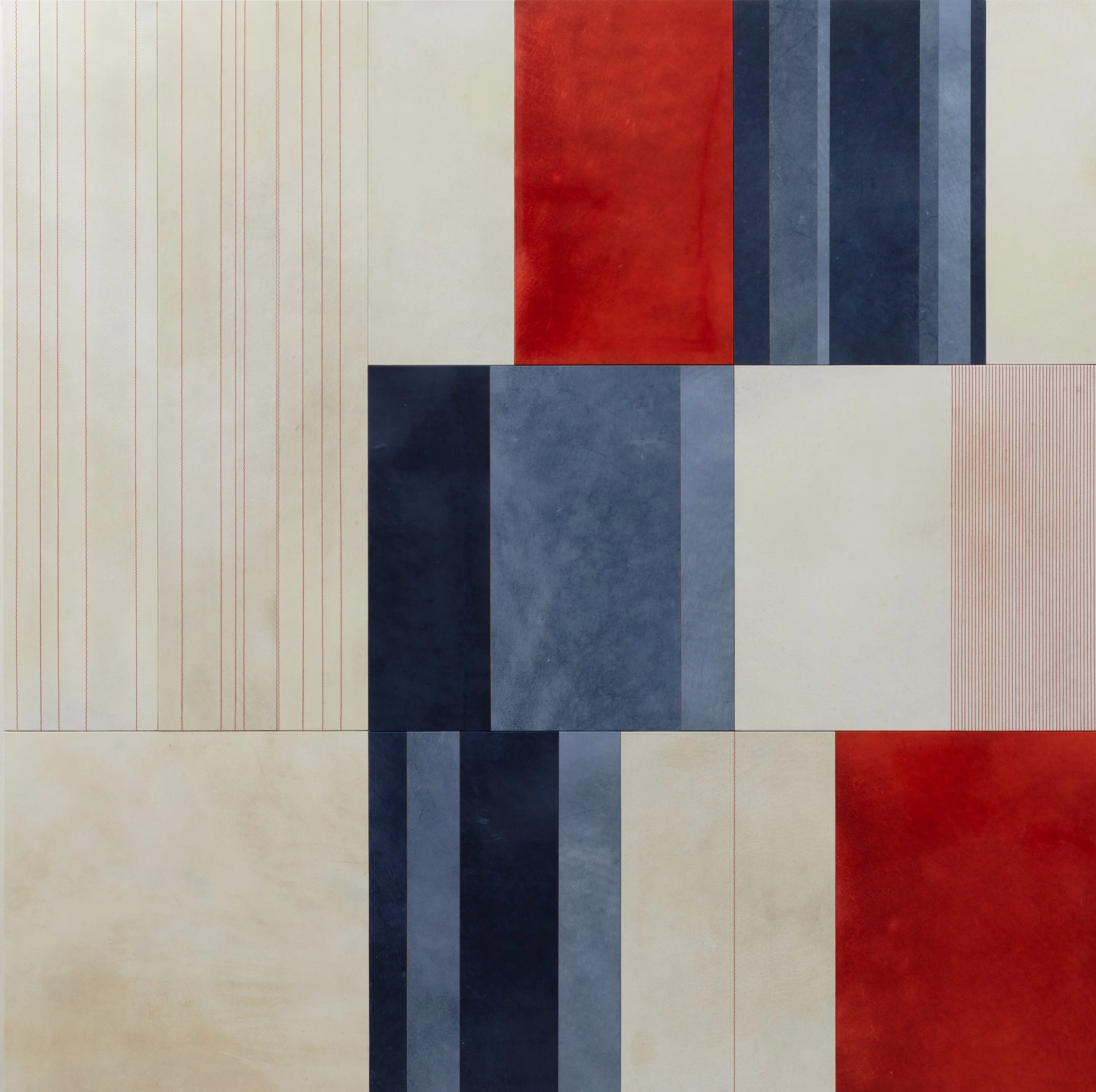
Thirteen Squares That Aren’t (2025)
Goat leather parchement inlay with stitching
120 × 120 × 4.5 cm.
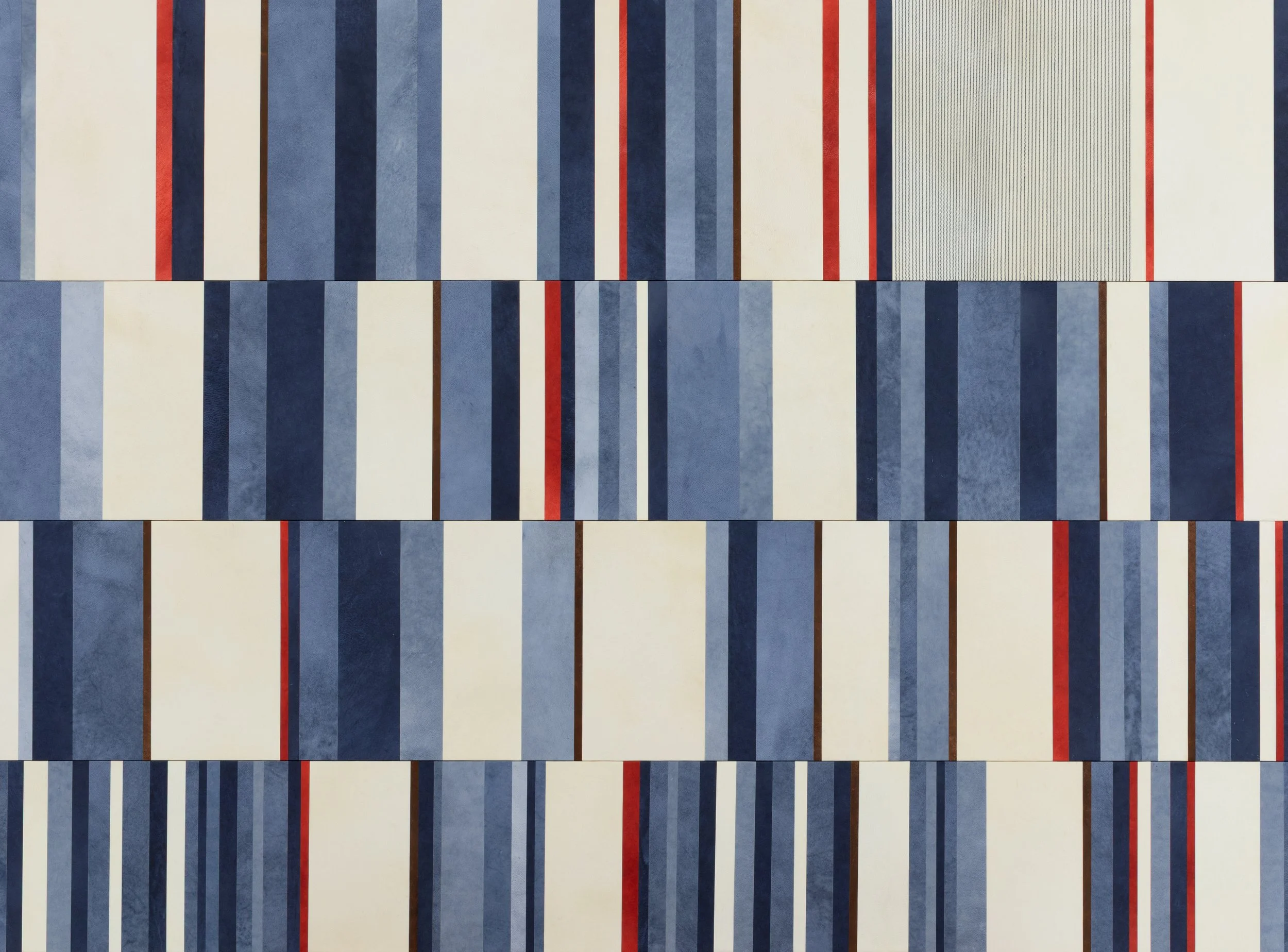
Unsquare Dance (2025)
Goat leather parchment inlay with stitching
100 × 136 × 4.5 cm.
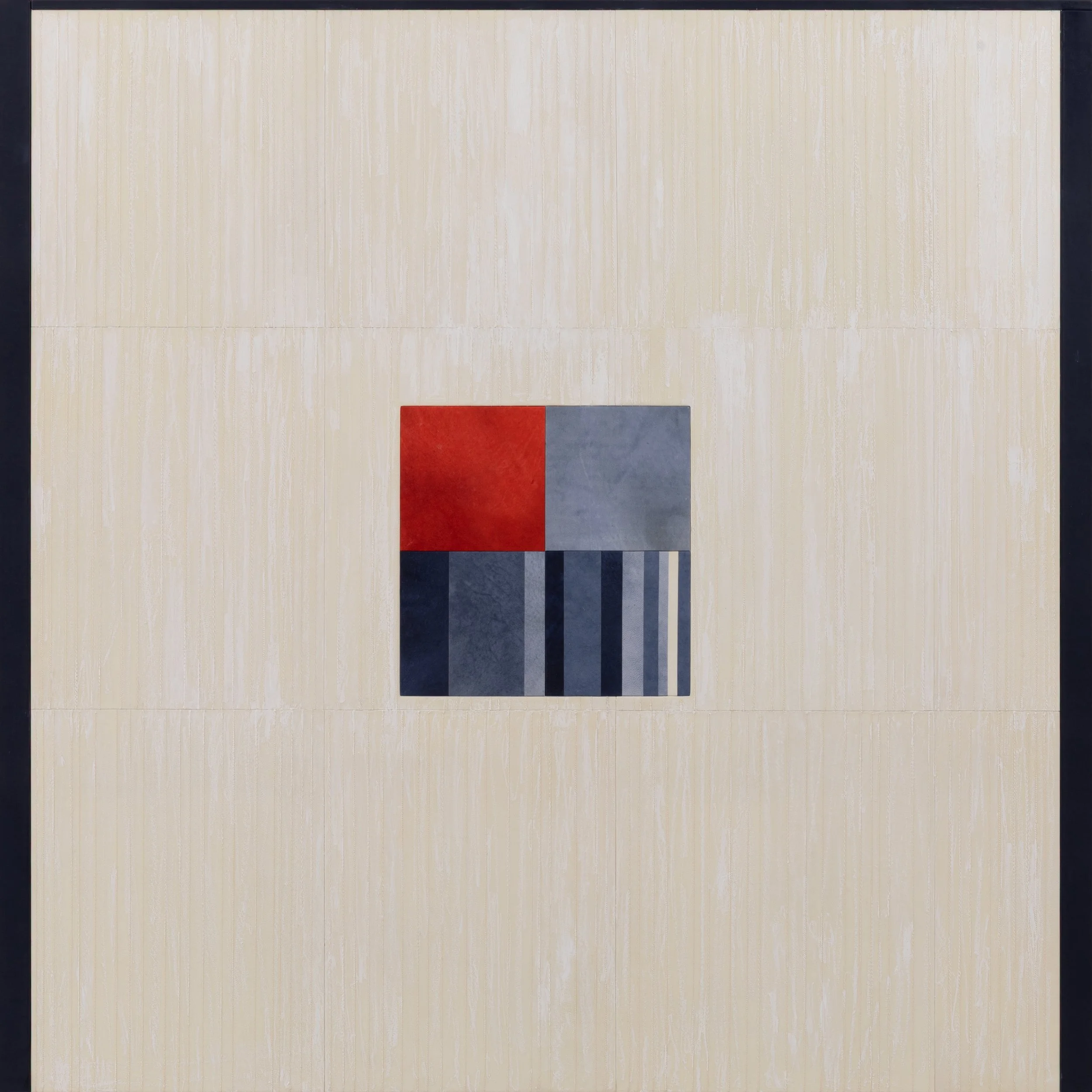
Quartet I (2025)
Goat leather parchment inlay with oil pastel on stitched goat leather parchment, composed with vegetable-tanned leather
120 × 120 × 4.5 cm.
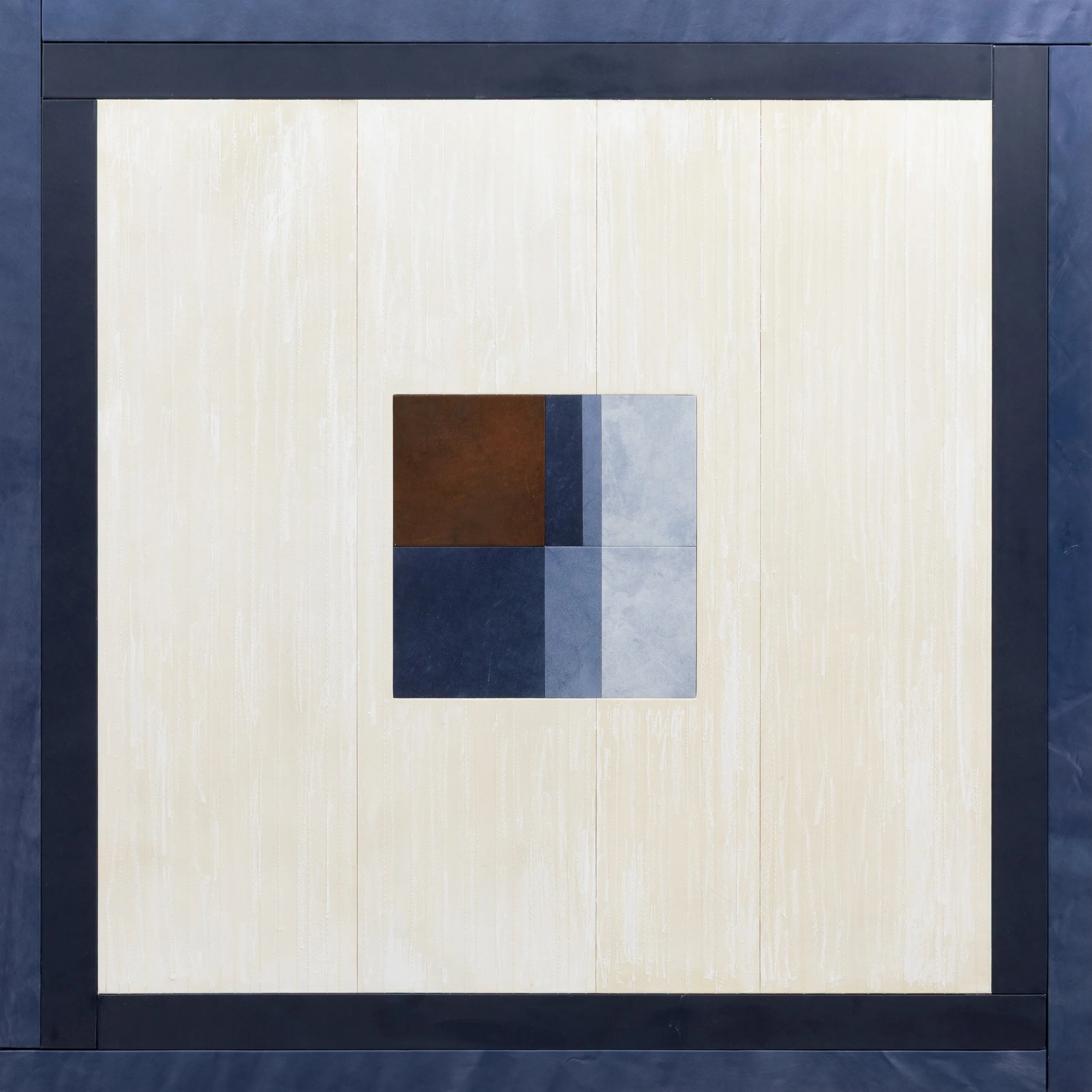
Quartet II (2025)
Goat leather parchment inlay with oil pastel on stitched goat leather parchment, composed with vegetable-tanned leather
100 × 100 × 4.5 cm.
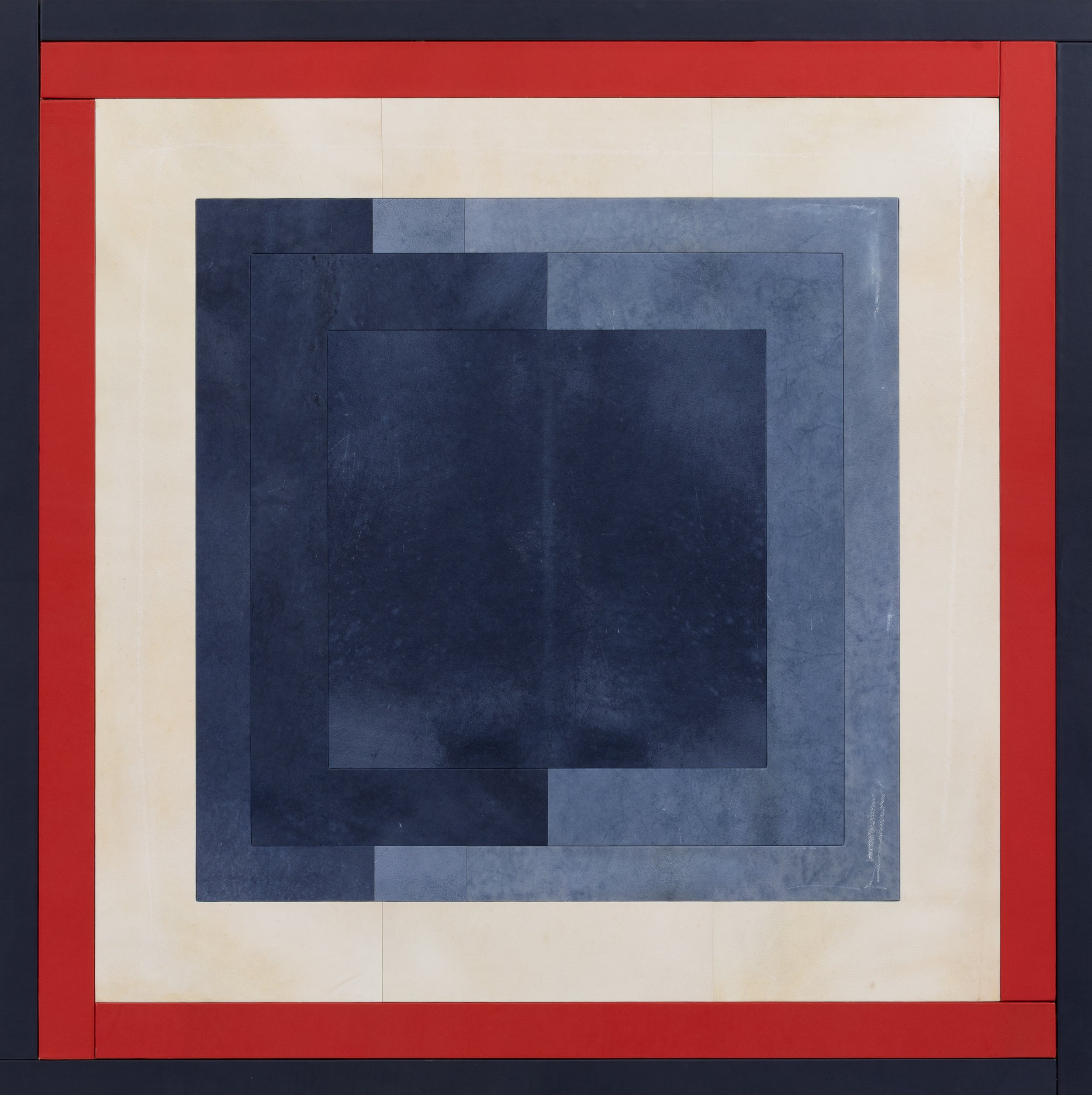
Blue Fugue (2025)
Goat leather parchment inlay with oil pastel on stitched goat leather parchment, composed with vegetable-tanned leather
100 × 100 × 4.5 cm.
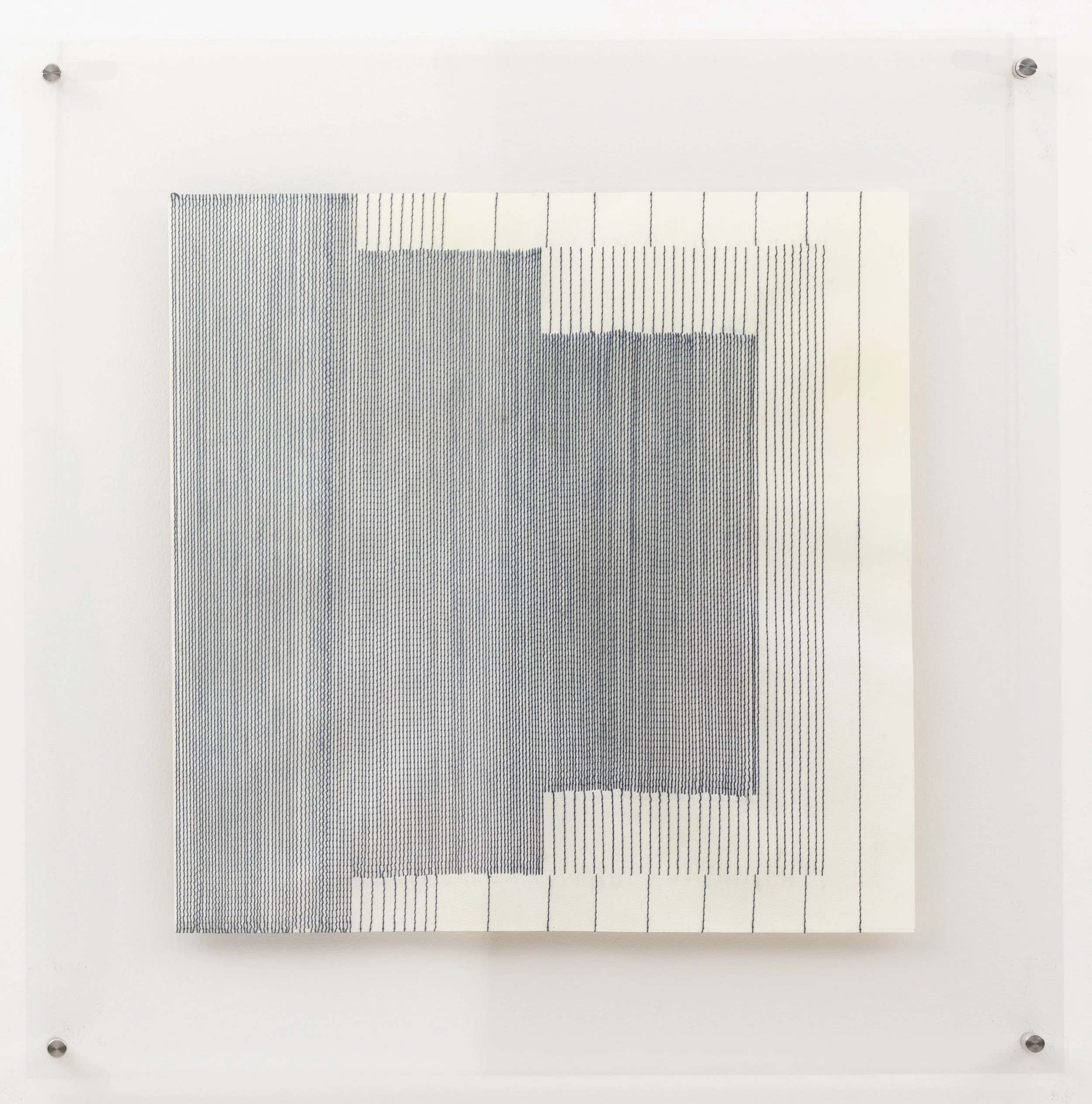
Tracing Lines (2025)
Stitching on goat leather parchment
46 × 46 (64 × 64 × 0.6 framed) cm.
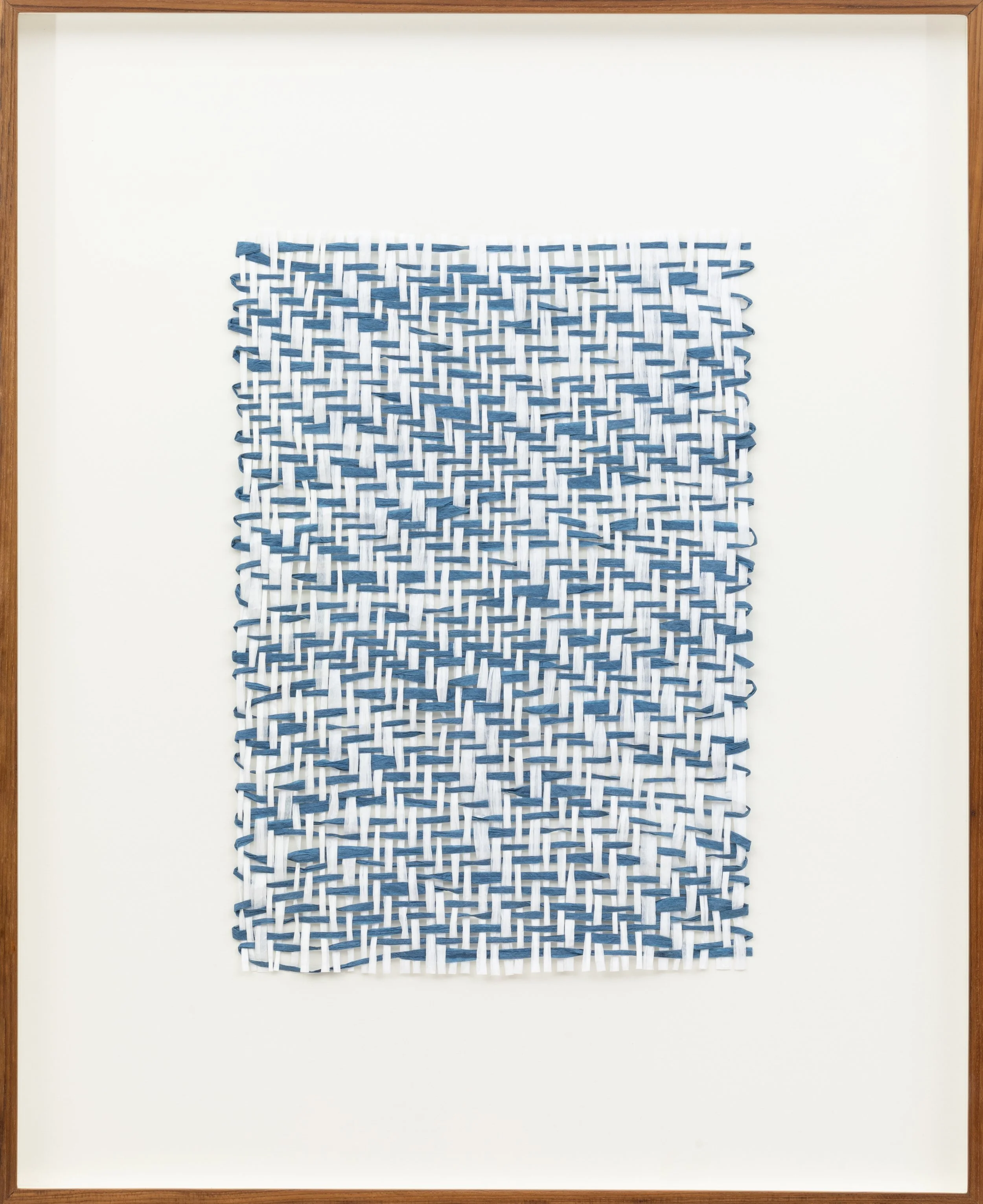
2/2 Twill (2025)
Raffia handloom weaving
34 × 24 (58 × 48 × 3.5 framed) cm.