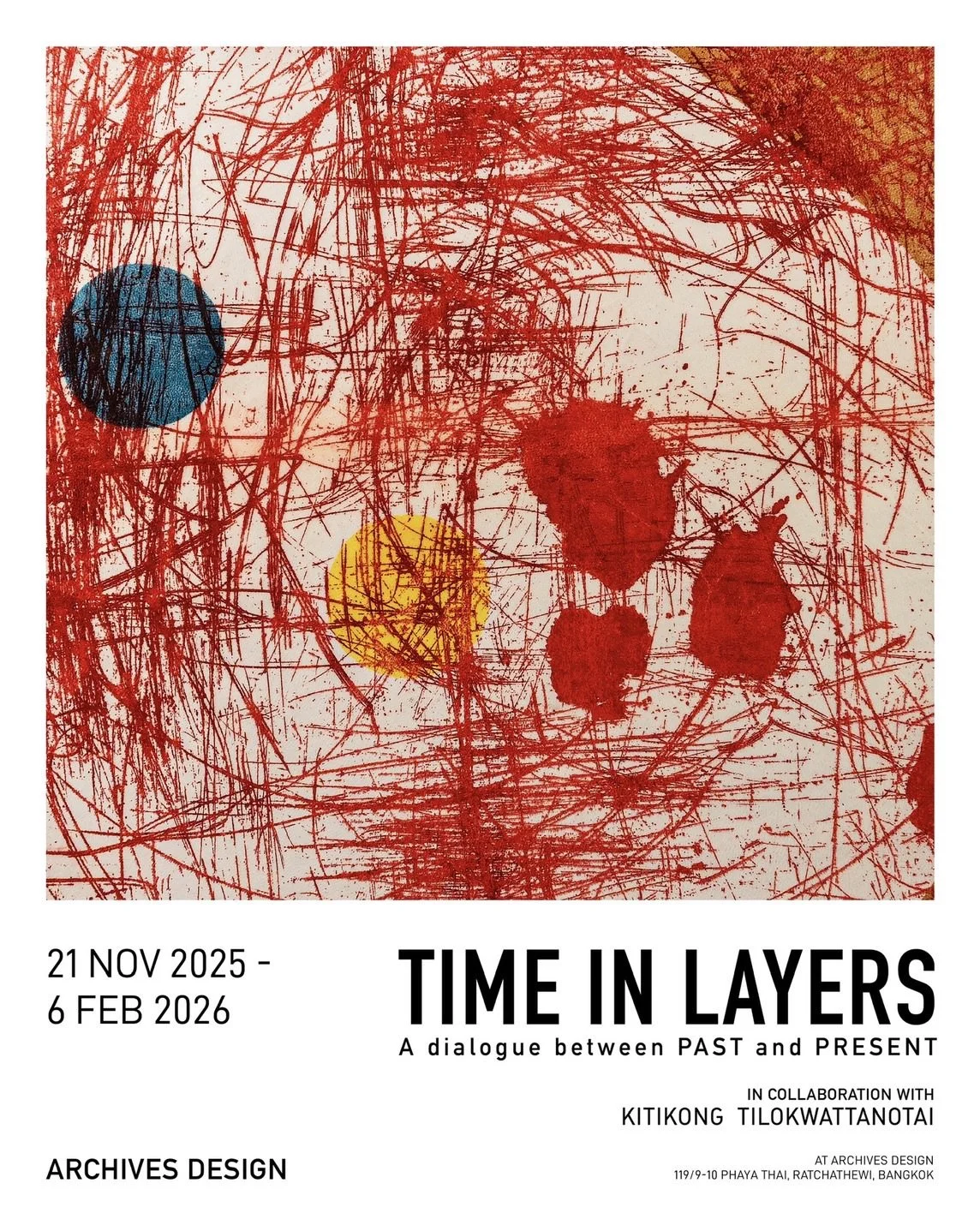
Time in Layers
A dialogue between PAST and PRESENT
in Collaboration with Kitikong Tilokwattanotai
For this collaboration, artist Kitikong Tilokwattanotai explores goat parchment as both medium and message — reviving one of the earliest materials once used for human documentation. Long before the invention of paper, parchment made from animal skin, whether goat or sheep, served as humanity’s first surface for thought, record, and imagination. By returning to this ancient material, Kitikong bridges past and present — connecting centuries-old craftsmanship with the expressive language of contemporary printmaking.
In this series, Kitikong explores the process of etching, one of the oldest printmaking techniques still practiced today. The process involves incising a design onto a plate before transferring it through ink and pressure. The process carries both precision and unpredictability — every mark made, every line etched, becomes a dialogue between the artist’s control and the material’s own response. When printed onto parchment, the result is a union of permanence and fragility, echoing the enduring yet delicate nature of memory itself.
Each piece is produced in a strictly limited edition of three, yet no two are ever identical. Every parchment bears its own organic history — lighter or darker tones, subtle scars, and surface irregularities. These natural variations, combined with the tactile unpredictability of etching, render each print a singular artwork, shaped as much by time and life as by the artist’s hand.
The imagery within these prints recalls the language of memory and play: swings, slides, climbing frames, and Pha Khao Ma (ผ้าขาวม้า) — the checkered cloth woven into Thai culture — reappear as abstract impressions rather than literal forms. Layers of color, scratch, and gesture echo the rhythm of childhood creation, where play becomes a form of mark-making. Just as children draw without knowing where their doodles will lead, each etched layer evolves freely, revealing compositions that are both spontaneous and profound.
Through “Time in Layers”, Kitikong reimagines etching as an act of rediscovery — grounding an age-old technique in an even older material. The result is a body of work that invites viewers to reflect on how memory, material, and making intertwine — how art, in its most elemental form, continues to preserve, transform, and reawaken our earliest sense of wonder.