

Soichiro Shimizu
b. 1966, currently lives and works in Bangkok, Thailand
Born in Tokyo in 1966, Soichiro Shimizu studied at the School of Visual Arts where he lived and worked in New York before moving to Bangkok. His paintings and engravings explore the duality of opposite aesthetic forces noted to the existence and deterioration of man and nature. He builds up layers through a physical rhythm of amplified motions, emphasizing his condition to affect the current nature of the materials, but at the same time destroying the many layers created. Aligning the residue of his past condition with his current self to uncover what’s beneath, the outcome of what is left is the result of what once existed, revealing what was always there to begin with.
His work has been exhibited in numerous galleries worldwide in New York, Paris, Milan, Tokyo, Seoul, and Bangkok. On the occasion of Soichiro Shimizu’s solo exhibition at Itochu Gallery, Tokyo in 1999 former director of MoMa Los Angeles, Jeffrey Deitch made note of Shimizu’s work “The tension created by the confrontation of opposite aesthetic forces is what gives the work its power. In his subtle way, Shimizu is an expert at stoking this aesthetic terrain by fusing opposing approaches to painting into a single work. He draws the viewer into his richly layered artistic world.”
From Flesh to Flux
In my artistic practice, I have long worked with materials that embrace deterioration—rust, erosion, disintegration—as a way to engage directly with time. For me, form is not defined by perfection, but by its ability to shift, to remain in motion, and to exist within uncertainty.
Leather, which I worked with for the first time in this exhibition, differs from my usual materials, yet it too carries time. It does not decay, but it remembers—holding the marks of tension, folds, and pressure; recording what has touched it.
But more profoundly, leather is skin—a surface that once lived. It once covered a moving body, one that bore wounds, illness, weight, fatigue, energy. These traces remain subtly on the surface. This residue of life gives leather a kind of emotional gravity unlike any other material.
In this work, I placed leather in conversation with copper—another material deeply responsive to fire and time. Copper yields to flame and records its transformations. Leather resists, absorbs, and softens. Each reflects a different mode of memory, a different way of transforming. In their interaction, they reveal a quiet dialogue between opposites.
The process of fixing particles onto the leather surface proved far more difficult than I had anticipated. What worked effortlessly on canvas resisted completely here. Through trial and error, I came to realize something essential: form does not arise from control, but from negotiation with the material.
Guided by the law of perpetual flux—the idea that all things flow and nothing remains unchanged—I accepted that instability as the essence of the work. Every fold, vibration, and imperfection became a fleeting form in motion, a mark etched in time.
In relation to this exhibition’s theme of modularity, I approached leather not as surface alone, but as a structural unit—skin reconfigured into form. Through repetition and subtle variation, the work breathes, hesitates, shifts. To not resist time, but to change with the material—that is what leather has taught me. And it is the essence of why I am here.
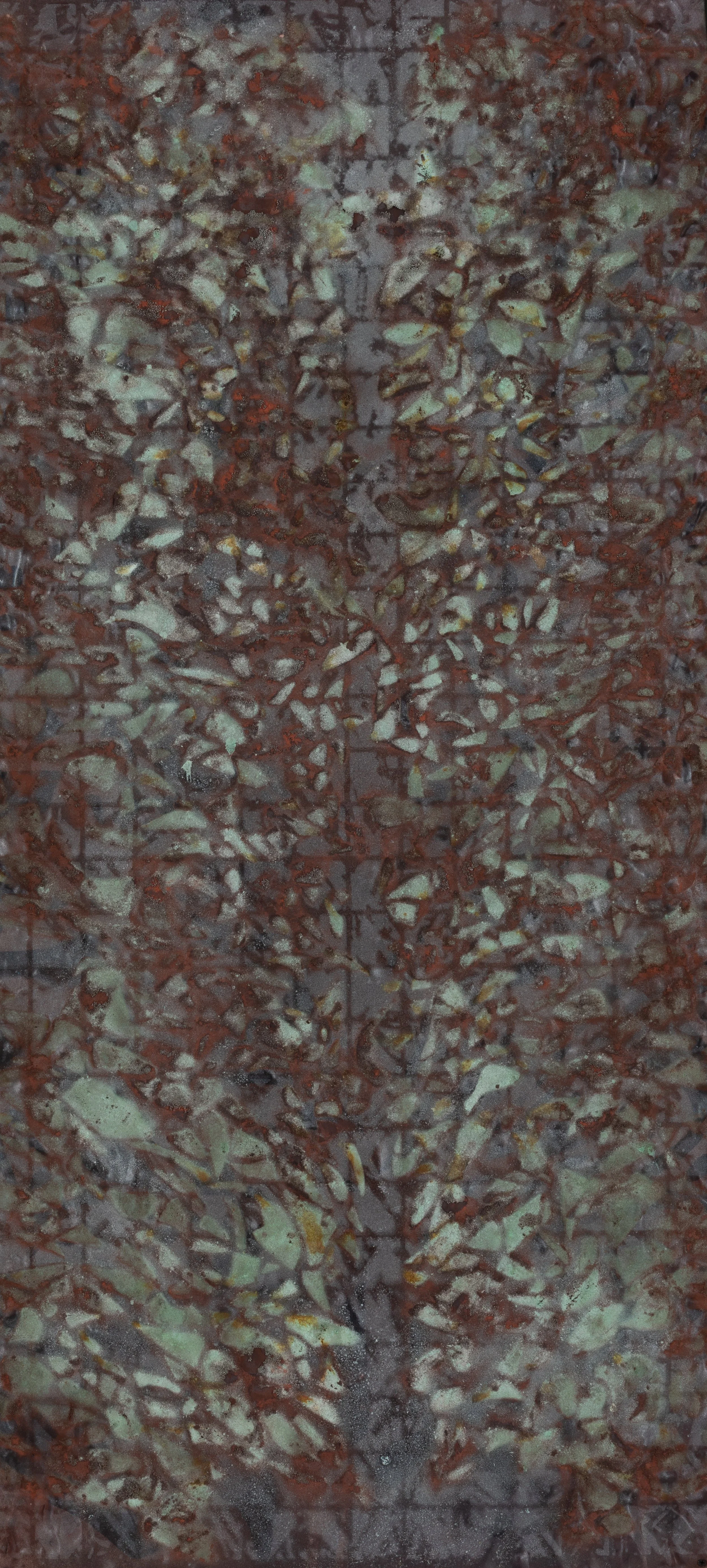
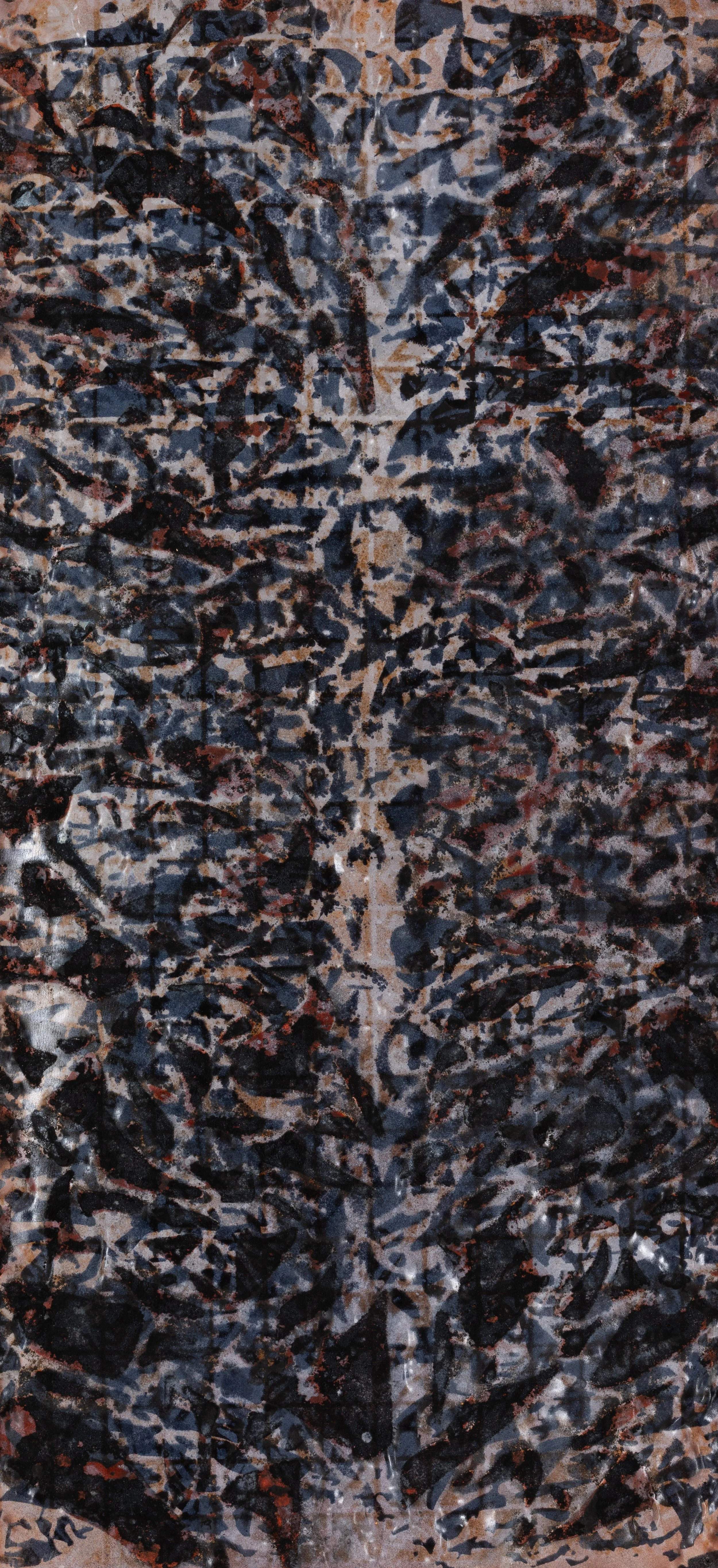
From Flesh to Flux I (2025)
Molded dyed vegetable-tanned leather, charcoal, copper, acrylic, patina
163 × 74 × 0.2 cm.
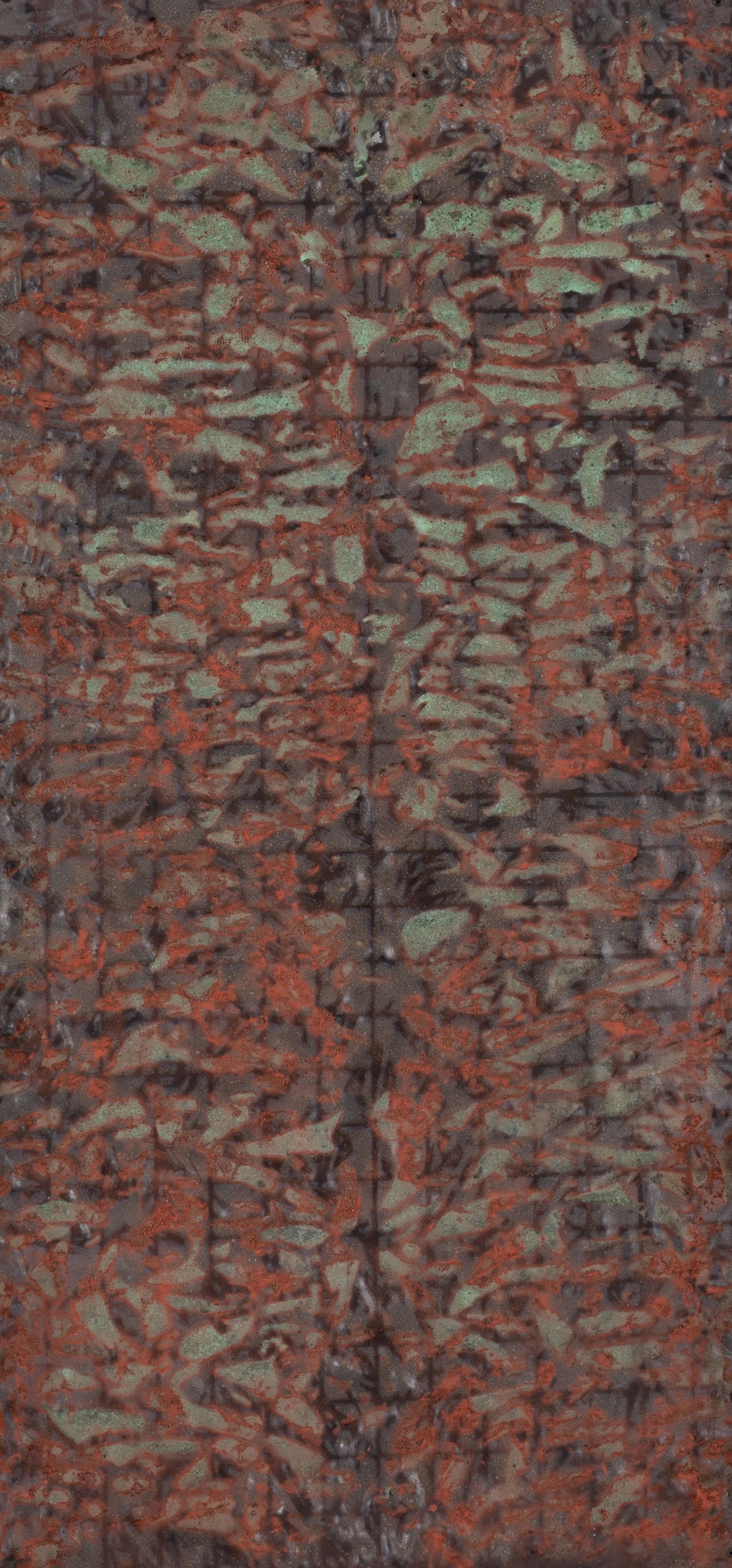
From Flesh to Flux II (2025)
Molded dyed vegetable-tanned leather, charcoal, copper, acrylic
163 × 74 × 0.2 cm.
From Flesh to Flux III (2025)
Molded dyed vegetable-tanned leather, charcoal, copper, acrylic, patina
163 × 74 × 0.2 cm.